
Traditional monolayer stretch films demand thick gauges to preserve load retention. That single compromise cascades into higher resin consumption, frequent film breakage, and rising per-pallet costs. A stretch film extrusion machine engineered around multi-layer co-extrusion eliminates this trade-off. Precision die geometry and balanced layer architecture deliver superior cling, puncture resistance and elongation.
Limitations of Monolayer Film
A monolayer film assigns every function to one formulation: tensile strength, puncture resistance, and cling all compete for the same resin chemistry. No single formulation optimizes all three simultaneously. Manufacturers compensate by adding thickness. This fix is crude and inefficient. Thicker rolls consume more resin, deplete faster, and demand more frequent changeovers. Monolayer film also lacks a reinforced core, so it fractures more readily under high pre-stretch tension. These inefficiencies compound, inflating the cost-per-pallet metric that packaging managers scrutinize most closely.
Where Load-Bearing Performance Matters Most
Battery module and photovoltaic panel packaging imposes exacting demands. Loads are heavy, edges are often jagged, and a single puncture can damage an expensive component. Conventional thick monolayer film survives these conditions, but only by sacrificing weight efficiency and inflating material cost.
Corrugated carton palletizing presents a different challenge: optical clarity. Warehouse staff need to verify labels and carton counts through the wrap during loading and staging. Monolayer film thick enough to withstand the load often sacrifices transparency in the process.
Construction insulation material introduces yet another variable — elastic recovery. Bulky, lightweight loads shift in transit unless the film sustains tension throughout the journey, not merely at the moment of wrapping. Films from older monolayer lines lose recovery force prematurely, a familiar culprit behind loosely wrapped insulation bundles.
What Multi-Layer Co-Extrusion Changes
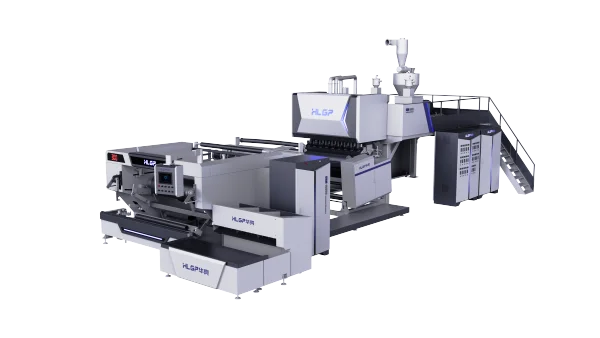
A multi-layer stretch film extrusion machine distributes function across dedicated layers instead of overburdening a single formulation. A flexible core layer absorbs tensile load; high-modulus skin layers govern cling and surface protection. Tackifiers, antiblock agents, and UV stabilizers occupy precise positions within this architecture, maximizing performance while minimizing material use.
This configuration enables downgauging of roughly 30% to 50% relative to monolayer film, without eroding the mechanical strength heavy pallets require — a direct remedy for the weight penalty afflicting battery and panel packaging. Precision extrusion control also unlocks elongation up to 300%, tripling the film's original length before failure. The payoff: more pallets wrapped per roll, fewer interruptions, and sustained throughput on corrugated palletizing lines. Independent layer tuning further permits outer layers optimized for elastic recovery and durable cling, granting insulation loads the sustained holding force monolayer film cannot reliably match.
Matching Layer Structure to Application
Applications rarely share identical requirements, so multi-layer stretch film extrusion machines are engineered in several distinct configurations. A five-layer structure incorporates two supplementary functional layers, unlocking extreme downgauging, exceptional puncture resistance, and precise additive placement — an apt solution for punishing loads like battery modules and photovoltaic panels, where a single puncture carries significant cost. A three-layer configuration serves as the industry standard, balancing gauge uniformity and cling control across a typical A/B/C or A/B/A architecture, suited to general-purpose palletizing such as carton stacking. A two-layer configuration offers a leaner co-extrusion alternative for basic bundling, providing consistent layer distribution and tear resistance where capital efficiency takes priority.
Automation and Gauge Consistency Under Continuous Load
Layer architecture addresses only half the equation. Repeatable performance across extended shifts hinges on process control. Fully automatic configurations integrate servo-driven winders, automated tension regulation, and real-time thickness monitoring, sustaining gauge consistency within roughly one micron — indispensable for high-volume, continuous operations like large-scale corrugated packaging lines. Semi-automatic configurations trade some continuous throughput for expedited recipe changeovers between layer structures, favoring operations alternating between load types — heavy battery packaging one shift, lightweight insulation bundling the next — without protracted setup.
The Cost Impact Is Quantifiable
A direct comparison against a monolayer baseline illustrates the advantage most clearly. Migrating from a 20-micron monolayer film to a 12-micron multi-layer film substantially reduces resin consumption per pallet. Paired with a stable 300% stretch ratio, identical raw material volumes now cover considerably more pallets. This synergy between gauge control and elongation efficiency typically yields a 15% to 25% reduction in total packaging expenditure — a consequential figure whether protecting photovoltaic shipments, corrugated cartons, or insulation bundles.
We engineer multi-layer stretch film extrusion machines in two, three, and five-layer configurations, complemented by fully automatic and semi-automatic winding options, so layer structure and automation align precisely with the load rather than forcing compromise. Whether the priority is maximum puncture resistance for high-value cargo, dependable clarity and cling for high-volume palletizing, or sustained holding force for bulky, lightweight materials, our co-extrusion lines deliver the downgauging, elongation, and gauge consistency that translate directly into reduced packaging expenditure.