
Manual roll changing is a common bottleneck in stretch film production. What appears to be a routine task often depends heavily on operator timing and experience, from stopping the winder and splicing the new core to managing tension during the transfer. This reliance on manual judgment can introduce variation between operators and shifts, while repeated line interruptions gradually erode effective production capacity.
The impact extends beyond lost production time. Hand-managed splicing can result in uneven film tails, misaligned joints, and unnecessary trim, increasing material consumption during continuous production. Tension can also fluctuate during transfer, contributing to winding defects such as telescoping and blocking. At the same time, manual roll handling requires operators to work closer to moving winding components during repetitive changeover procedures. These limitations can become increasingly significant as manufacturers seek higher throughput and more automated production.
How Manual Roll Changes Affect Film Quality
The consequences of roll-changing practices become more apparent once finished rolls enter downstream packaging operations. In e-commerce and warehouse logistics, stretch film rolls may be used on automated wrapping equipment, where variations in winding quality can affect feeding and wrapping performance. In building material and profile packaging, poorly executed splices or inconsistent roll formation can become more noticeable during handling and long-distance transit.
For heavy goods and industrial packaging, uniform winding tension helps produce rolls that behave more predictably during subsequent wrapping and handling. This makes roll changing more than a simple operational task. It is an integral part of maintaining finished-roll quality, material efficiency, and production continuity.
Automatic Roll Change for Continuous Production
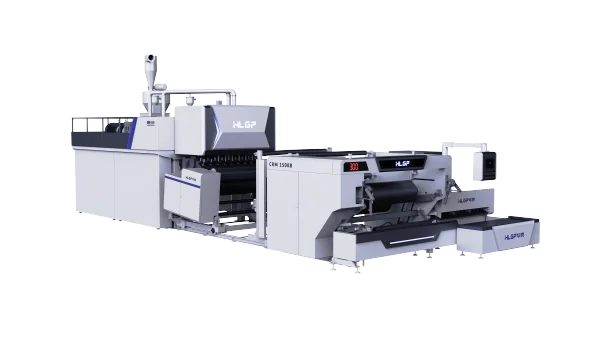
Automatic roll change (ARC) technology addresses these limitations by transferring production from one finished roll to the next with significantly less operator intervention. An ARC-equipped stretch film extrusion machine can use servo-driven synchronization to coordinate the transfer, splice, and cutting sequence while keeping the extrusion process running.
Instead of repeatedly stopping the line for manual changeovers, the system is designed to maintain production continuity while the winding section transitions between rolls. For high-volume operations, eliminating frequent interruptions can increase effective production time over the course of a shift without requiring a higher extrusion rate.
The value of ARC therefore lies not simply in automation itself, but in minimizing the operational variability associated with repetitive manual changeovers.
Automatic Tension Control During Roll Changes
Winding tension is a critical factor in determining the structure and handling characteristics of a finished film roll. During a manual changeover, tension can fluctuate as the operator coordinates the transfer, splice, and winding process. An automated system can instead use controlled tension management to maintain a more stable winding profile throughout the transition.
This helps create rolls with more uniform winding characteristics and can reduce the likelihood of defects such as telescoping and uneven roll formation. More predictable winding also benefits downstream converting and wrapping operations, where roll stability and feeding behavior influence overall equipment performance.
By shifting tension management from manual adjustment to automated control, ARC technology provides a more repeatable winding process, particularly when the line operates continuously or at higher production speeds.
Lower Material Waste During Changeover
Material efficiency is another important consideration. Manual changeovers can generate scrap through uneven film tails, poorly aligned splices, and excess material used during the transfer. Although the amount generated during an individual changeover may appear modest, repeated losses can become significant across a high-volume production schedule.
Automatic roll change technology coordinates the transfer and cutting sequence with greater repeatability, helping minimize unnecessary scrap at the end and beginning of successive rolls. For manufacturers producing stretch film for building materials, profiles, logistics, or industrial packaging, better changeover efficiency can help reduce resin consumption and support tighter control over the cost of finished rolls.
The benefit is particularly relevant when resin prices represent a substantial portion of overall production costs. Improving the utilization of material already entering the extrusion process can often be more practical than pursuing savings elsewhere in the production line.
Reducing Manual Handling on the Production Floor
Automation also changes the operator's role during roll changes. Instead of requiring personnel to perform repetitive transfer procedures close to moving winding components, an ARC system can automate key stages of the changeover sequence.
This reduces the amount of direct manual intervention required during routine roll transfer and allows operators to devote more attention to process monitoring, quality inspection, and production management. The result is a production workflow that relies less heavily on individual operator timing while giving technical staff greater visibility over overall line performance.
For facilities operating extended production schedules, this shift from repetitive manual intervention toward process supervision can provide a more structured and manageable operating environment.
Automatic Roll Change for High-Output Production
For manufacturers seeking higher production efficiency, automatic roll change technology addresses several limitations inherent in manual winding operations. By minimizing changeover interruptions, stabilizing the transfer process, improving material utilization, and reducing repetitive manual handling, ARC can become an important part of an automated stretch film extrusion line.
We integrate automatic roll change systems into our stretch film extrusion machine lineup to support continuous production and more consistent roll formation. The system is designed to coordinate winding, transfer, splicing, and cutting with minimal operator intervention, helping manufacturers maintain a more predictable production rhythm.
Whether the requirement is a high-output line for large-scale packaging production or a more flexible configuration for varied film applications, our extrusion systems can be configured around the required film structure, production capacity, and automation level. By combining controlled extrusion with automated roll handling, we help manufacturers move beyond the limitations of stop-and-start changeovers and build a more efficient, repeatable production process.