
Fully automatic production is often associated with higher efficiency, but maximum automation is not always the most practical choice for every stretch film manufacturer. Production requirements vary between factories, particularly when orders involve different stretch film widths, roll lengths, core sizes, or short production runs. In these environments, a semi-automatic stretch film extrusion machine can provide a more practical balance between extrusion performance, changeover flexibility, investment cost, and operator control.
Rather than automating every stage, a semi-automatic configuration combines automated extrusion and process control with a winding section that allows operator intervention where it is most useful. For manufacturers handling customized orders or fluctuating volumes, that flexibility can be more valuable than adding automation to every operation.
When Production Flexibility Matters More Than Full Automation
A highly automated stretch film production line is designed to minimize manual intervention, but frequent specification changes make that approach less straightforward. Changing film width, roll length, core diameter, or other winding parameters requires adjustments to machine settings, and when this happens repeatedly through the day, the time required for each transition affects overall efficiency.
This is particularly relevant for manufacturers serving customized packaging requirements. Short-run orders may not justify dedicating a fully automated line to a single specification, while frequent changes reduce the utilization of equipment built for long, standardized runs.
A semi-automatic stretch film extrusion machine approaches this differently. Automated extrusion and temperature control maintain the core processing functions, while the winding section gives operators a more direct role in handling different requirements, letting the setup adapt to changing orders without unnecessary automation at every stage.
Faster Changeovers for Variable Orders
Changeover efficiency matters when production involves multiple stretch film specifications. A semi-automatic winding system lets operators adjust or replace cores and change roll configurations with less dependence on complex automated programming.
For cosmetics and personal care packaging, orders may involve different stretch film widths or roll specifications depending on the packaging format, and a flexible winding process lets these changes happen as part of normal production rather than requiring the line to be optimized around one fixed configuration.
The same applies to outdoor and sporting goods packaging, where export orders vary in stretch film dimensions and roll requirements. Instead of maximizing automation for one repetitive cycle, a semi-automatic machine can prioritize adaptability across order types — suited to manufacturers whose advantage comes from responding quickly rather than producing only large volumes of standardized film.
A Simpler Architecture for Easier Maintenance
Additional automated mechanisms also add system complexity. Fully automated winding systems may incorporate more sensors, actuators, drives, and control functions, all requiring maintenance and troubleshooting.
A semi-automatic configuration uses a simpler winding architecture while retaining automated control over extrusion. Fewer automated mechanisms make routine inspection more straightforward, particularly where maintenance teams are more experienced with conventional mechanical and electrical systems than specialized robotics.
This doesn't mean semi-automatic equipment is maintenance-free — extruders, heating systems, drives, bearings, winding components, and electrical controls still need regular servicing. But a simpler structure makes components easier to access and understand, helping operators identify issues more efficiently. For manufacturers in regional hardware and electromechanical component distribution, where volumes fluctuate and priorities shift often, maintainability can matter as much as peak automation.
Real-Time Quality Control During Winding
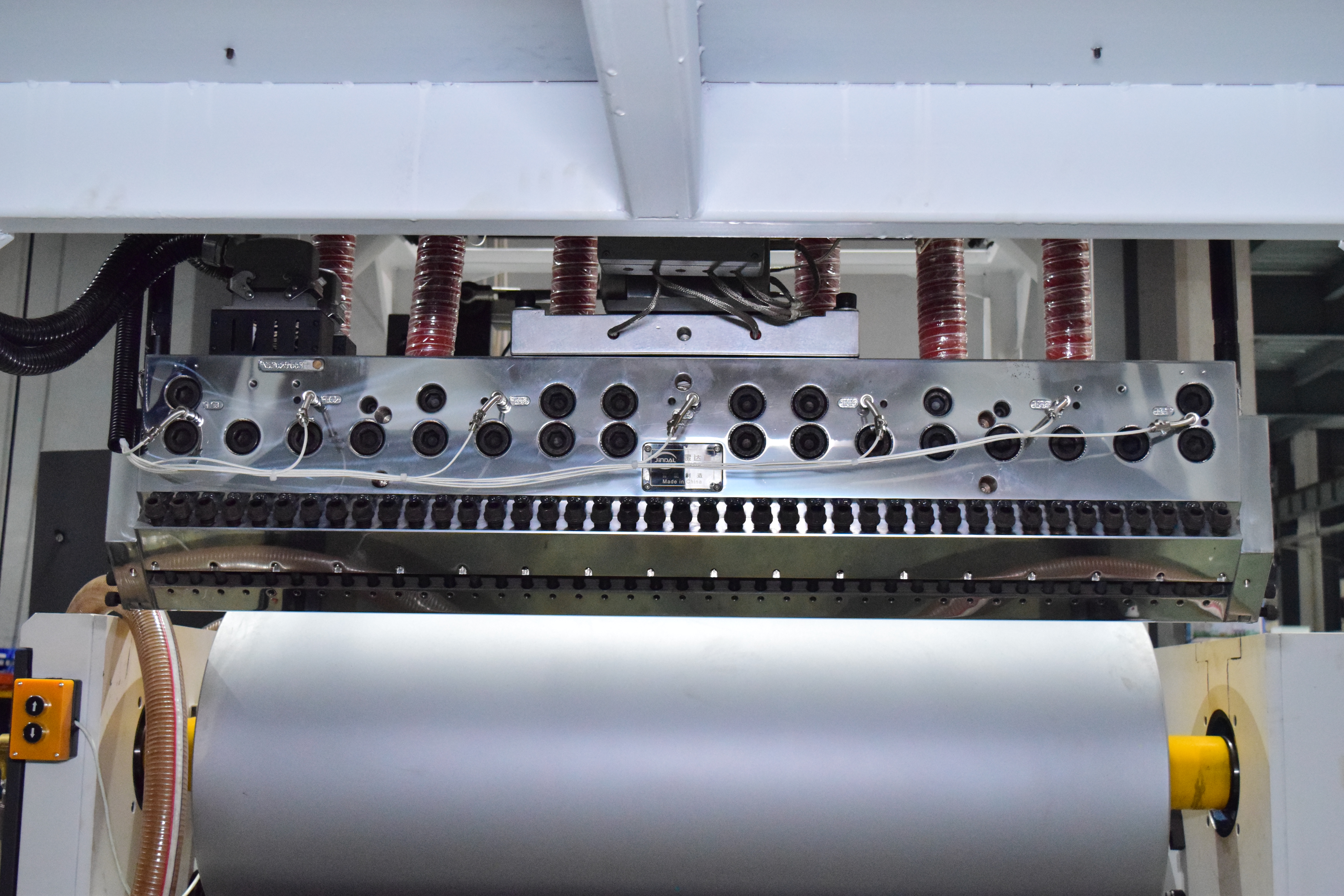
One advantage of operator-assisted winding is direct visibility during production. While automated systems monitor defined parameters through sensors, an experienced operator can also observe the finished stretch film and winding condition during roll formation.
Film appearance, winding tension, roll formation, and edge condition can be checked as production continues, so if an abnormality appears the operator can respond promptly rather than waiting until the roll is removed for inspection. This is especially useful for customized or short-run orders, where each batch may differ — operators can verify whether the film and finished roll are developing as expected while the line runs, helping prevent a small deviation from becoming a larger batch of rejected material.
Material Efficiency and Online Trim Recycling
Stretch film production inevitably generates edge trim during width adjustment and other processing stages, which becomes scrap without an appropriate recycling system. An online edge-trim recycling system can return suitable trim to the extrusion process, reducing waste and improving resin utilization — a capability that, integrated with a semi-automatic machine, complements the flexible production model across different film specifications.
Recycling should still be managed according to resin formulation, application, and required quality level, since not all recycled material can be introduced at the same proportion for every product, particularly when the finished film requires specific mechanical or optical properties.
Balanced Energy and Investment Requirements
The investment decision for extrusion equipment should consider more than purchase price — machine complexity, installed power, maintenance needs, operator requirements, and expected utilization all contribute to total cost of ownership. A semi-automatic stretch film extrusion machine generally avoids some automation hardware associated with fully automated winding systems, which can reduce initial investment and simplify the equipment structure.
For small and mid-sized manufacturers, this matters when volumes are still developing or the business is expanding into customized stretch film orders — rather than investing immediately in a highly automated system built for large-scale standardized production, manufacturers can select a configuration closer to their actual production pattern. Energy consumption also depends on extruder size, motor efficiency, heating requirements, film thickness, and production speed, so a line should be evaluated on its complete operating profile rather than automation level alone.
A Practical Choice for Flexible Stretch Film Production
The value of a semi-automatic stretch film extrusion machine lies in the balance it provides: automated extrusion and process control support stable production, while operator-assisted winding provides the flexibility needed for changing specifications and shorter runs. For manufacturers serving cosmetics and personal care packaging, outdoor and sporting goods, hardware distribution, or other varied markets, this combination simplifies changeovers, gives operators direct visibility during roll formation, supports practical maintenance, and can combine with online edge-trim recycling for improved material utilization.
Our semi-automatic stretch film extrusion machines are developed for manufacturers who need reliable LLDPE stretch film production together with practical flexibility. We combine controlled extrusion, stable temperature management, configurable film production, and an operator-assisted winding system suited to varied requirements, with the option to add online edge-trim recycling and other auxiliary systems for efficient material use.
For producers handling custom orders, changing stretch film specifications, or fluctuating volumes, a semi-automatic stretch film extrusion machine offers a balanced path between manual operation and full automation — a production system designed around how orders are actually processed, while retaining the automation needed for stable, efficient extrusion.