
Protective packaging increasingly needs to balance cushioning performance, mechanical strength, material efficiency, and consistent quality. Traditional single-layer and low-layer-count bubble film lines can produce standard protective film, but they offer limited control over how different material properties are distributed within the film structure. For manufacturers serving demanding packaging applications, a 7-layer bubble film extrusion machine provides greater flexibility by combining multiple resin layers in one continuous production process.
Where Conventional Bubble Film Lines Struggle
Single-layer and basic two-layer equipment limits how manufacturers can balance different film properties. When a film needs stronger mechanical performance, better moisture resistance, or improved cushioning, a low-layer structure may require compromises in material selection or film thickness. In some applications, additional lamination may also be needed to introduce properties that cannot be achieved within the original structure.
Older equipment can also create production consistency issues. Uneven temperature control, unstable extrusion conditions, and inconsistent cooling may lead to variations in film thickness and bubble geometry. These problems can increase scrap rates and make it harder to maintain consistent film quality across long production runs.
A modern multi-layer line addresses these limitations at the extrusion stage. Instead of relying on a single formulation to provide every required property, manufacturers can assign different functions to different layers and adjust the structure according to the application.
Multi-Layer Co-Extrusion for Functional Film Structures
The main technical advantage of a 7-layer bubble film extrusion machine is its ability to build a film structure from multiple independently controlled resin layers. Each extruder can supply a specific material, allowing the final film to combine different mechanical and functional properties within one structure.
For example, outer layers can be designed around surface characteristics and mechanical durability, while inner layers can focus on cushioning performance or material efficiency. Depending on the available resin combinations and machine configuration, manufacturers can also incorporate recycled polyolefin materials into selected layers without making the entire film structure dependent on recycled content.
This layer-by-layer approach gives producers more control over film performance than a basic monolayer structure. It also eliminates the need to manufacture separate films and combine them through an additional lamination process when the required properties can be achieved through co-extrusion.
The result is greater flexibility in resin selection, layer ratios, and film design. Manufacturers can adjust the structure for different packaging requirements while using the same production platform.
Vacuum Forming for Consistent Bubble Structure
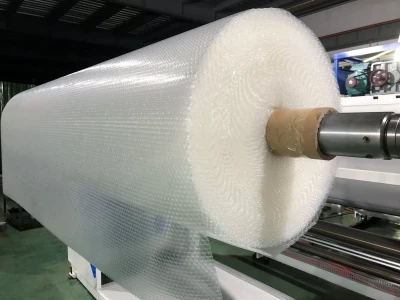
Bubble geometry is another important factor in protective film production. The forming section must stabilize the molten film while cooling it sufficiently to maintain consistent bubble dimensions. A vacuum forming roller helps draw the film against the forming surface, supporting more uniform bubble formation and controlled cooling.
Stable forming conditions can help reduce variations in bubble height, cell shape, and overall film appearance. This is particularly important during continuous production, when changes in cooling or forming conditions can otherwise affect film consistency across different production runs.
Consistent bubble geometry also helps manufacturers maintain predictable cushioning characteristics. Instead of depending on irregular bubble formation to provide protection, the production line can maintain a more controlled cellular structure across the film width.
For converters supplying electronics, industrial components, furniture, and other products that require reliable cushioning during transportation, this consistency can simplify downstream packaging operations and reduce quality variations between rolls.
PLC Control for Stable Production
A 7-layer bubble film extrusion machine also depends on coordinated control across multiple processing stages. PLC-based control systems can manage key production parameters such as extrusion conditions, heating zones, line speed, and winding operation from a centralized interface.
This integration reduces the need for operators to make frequent manual adjustments during normal production. When process parameters remain stable, manufacturers can achieve more consistent film thickness, bubble formation, and winding quality from one production run to another.
For multi-layer extrusion, coordinated control is especially important because changes in one part of the process can affect the final film structure. Independent extrusion systems must remain synchronized with the forming, traction, and winding sections to maintain stable output.
A well-integrated control system therefore does more than simplify operation. It provides operators with better visibility over the production process and makes it easier to repeat established processing conditions when switching between production orders.
Material Efficiency and Production Flexibility
One of the practical benefits of multi-layer extrusion is the ability to place materials where their properties are most useful. Instead of increasing the thickness of the entire film to improve one performance characteristic, manufacturers can adjust individual layers according to the application.
This approach can improve material utilization while maintaining the required combination of cushioning, strength, and surface performance. It also creates opportunities to use different resin grades strategically, including recycled material in suitable layers where the target application permits it.
For manufacturers producing several bubble film specifications, this flexibility can be valuable. Different layer ratios and resin combinations can support different products without requiring a completely separate production line for every film structure.
The ability to produce multiple specifications on one platform also helps manufacturers respond to changing customer requirements. Packaging orders may vary in thickness, bubble structure, material composition, and performance requirements, making production flexibility an important part of equipment selection.
Designed for Continuous, High-Volume Production
Multi-layer bubble film production is most valuable when the equipment can maintain stable operation over extended production periods. Automated material feeding, synchronized extrusion, controlled bubble forming, traction, and winding allow the complete line to operate as an integrated process.
Stable continuous production helps reduce interruptions caused by manual adjustments and minimizes the material waste associated with unstable start-up or process fluctuations. For manufacturers operating large production schedules, these improvements can have a direct effect on resin consumption, output consistency, and operating efficiency.
The combination of multi-layer co-extrusion and automated process control also makes it possible to produce more sophisticated bubble film structures at commercial scale rather than limiting them to small specialty batches.
Applications Requiring Consistent Protective Performance
The flexibility of a 7-layer bubble film extrusion machine makes it suitable for manufacturers producing protective packaging for a wide range of applications. Electronics and precision components may require controlled cushioning and stable film quality, while furniture and industrial products can require larger-format protective film with sufficient mechanical durability for handling and transportation.
The exact film structure should be selected according to the product being protected, required cushioning performance, resin characteristics, and production requirements. A multi-layer extrusion platform gives manufacturers more options to make these adjustments at the film-production stage.
Our 7-layer bubble film extrusion machine combines multi-layer co-extrusion, vacuum forming, and centralized PLC control to provide greater control over film structure and production stability. By allowing different resins to perform specific functions within the same film, the machine gives manufacturers more flexibility in material selection, product development, and production planning. It can be configured around your target film structure, resin strategy, output requirements, and application needs.