
Packaging manufacturers are under constant pressure to balance per-unit material costs with strict protective packaging requirements. Cost pressure, throughput targets, and rising expectations for reliable shipment protection all influence the choice of bubble film machine. An over-engineered system can increase costs, while a machine that cannot deliver the required film performance can contribute to damaged shipments and customer complaints. The choice between a 2-layer and a 7-layer bubble film extrusion machine ultimately depends on production requirements, film performance, and cost priorities.
Where Standard Protective Films Fall Short
Many packaging operations still rely on outdated equipment. A basic monolayer or simple co-extrusion setup can produce serviceable film but may struggle to meet more demanding performance requirements. Improving puncture resistance and tear strength can come at the expense of clarity. Cushioning performance can also be difficult to optimize without increasing material thickness, which raises resin consumption and freight weight at the same time. And because a simple single-layer structure cannot assign different polymer grades to specific functional layers, manufacturers may be forced to overbuild the entire film just to protect one vulnerable area.
The Role Bubble Film Plays Across Modern Packaging
Bubble film has become the default cushioning layer across an unusually wide span of industries precisely because it absorbs impact without adding much weight or cost relative to foam or molded alternatives. E-commerce fulfillment centers rely on it to protect everything from small electronics to fragile home goods through multi-leg parcel networks. Appliance and furniture manufacturers use it to guard painted or glass surfaces during transit and warehouse handling. Automotive parts suppliers and precision instrument makers depend on it where a single scratch or impact fracture can turn a shipment into a warranty claim.
What differs across these industries is not whether bubble film is useful, but how much performance each application actually demands. A retailer shipping lightweight consumer goods and an automotive parts exporter shipping machined components are both buying "bubble film," but they are not buying the same film — and increasingly, they are not buying it from the same production line either. This is exactly the gap that separates 2-layer and 7-layer bubble film extrusion machine configurations.
What Sets a 2-Layer Bubble Film Extrusion Machine Apart
A 2-layer bubble film extrusion machine remains the practical backbone for a large share of protective packaging production, and for good reason. With a single main extruder or a compact dual-screw configuration, typical screw diameters in the 65 to 90 millimeter range, and output capacities generally falling between 150 and 300 kilograms per hour depending on film width and gauge, these machines deliver standard-grade bubble film without the capital burden of a full multi-layer co-extrusion system.
Because the layer structure is simpler, changeovers are faster, resin formulations are easier to manage, and maintenance demands stay modest — all of which keep operating costs predictable. That combination makes 2-layer machines a strong fit for small and mid-sized packaging converters, regional e-commerce fulfillment operations, and manufacturers producing routine protective packaging for appliances, furniture, and general consumer goods. In these applications, film needs to be reliably cushioning and cost-efficient far more than it needs multi-functional layering, and a 2-layer bubble film extrusion machine is built exactly for that job.
How 7-Layer Co-Extrusion Changes the Performance Equation
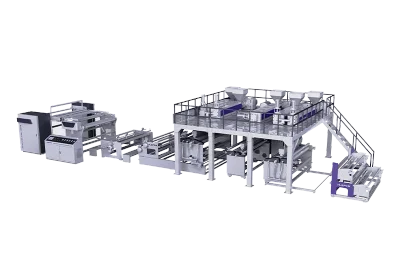
A 7-layer high-speed bubble film extrusion machine solves a different problem. Rather than running one formulation through the entire film, it uses multiple extruders — often five or more feeding into a single die assembly, with screw diameters reaching up to roughly 95 millimeters and combined output capacities up to around 500 kilograms per hour — to place distinct polymer grades exactly where they contribute the most value. Structural resins concentrate in the core layers to maximize puncture and tear resistance. Virgin polymer grades sit in the outer layers to preserve sealability and optical clarity. Dedicated barrier materials occupy their own layer to enhance protective performance without adding unnecessary bulk elsewhere in the film.
This precise layer allocation is what allows a 7-layer machine to break out of the traditional cost-versus-performance trade-off. Rather than overbuilding the whole film to compensate for one weak property, manufacturers can engineer each layer for its specific function, which often reduces total resin consumption even as mechanical and barrier performance improve. That is what makes 7-layer output suitable for automotive component export packaging, precision electronics and instrument protection, and premium retail brand packaging, where buyers are evaluating film on strength, clarity, and consistency simultaneously — not on any single property in isolation.
Matching the Machine to Your Production Goals
The right choice ultimately comes down to what your customers are actually paying for. If your production runs are cost-sensitive, standardized, and focused on general cushioning performance, a 2-layer bubble film extrusion machine offers the most direct path to profitability. If your customer base includes automotive, electronics, or premium retail accounts that specify mechanical performance, barrier properties, and film clarity as purchase criteria, a 7-layer high-speed machine turns those requirements into a competitive advantage rather than a cost center. Many manufacturers ultimately run both configurations side by side, using 2-layer lines for volume-driven standard packaging and 7-layer lines for higher-margin, specification-driven orders.
Our bubble film extrusion machine lineup spans both ends of this decision, from streamlined 2-layer systems built for reliable, cost-efficient output to advanced 7-layer high-speed platforms engineered for precise multi-material layering and demanding industry specifications. Whether your priority is maximizing throughput on standard protective film or delivering premium, high-barrier packaging that meets automotive and retail-grade standards, our engineering team can help you evaluate line speed, layer configuration, and output capacity against your actual production mix — so the machine you invest in matches the film your customers are actually asking for.